Saving Energy in Data Centers
A group at Microsoft Research attacks the problem on two fronts.
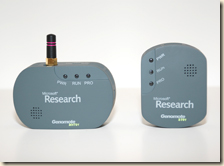
Monitoring the conditions: This sensor, a prototype developed by the Networked Embedded Computing group at Microsoft Research, is sensitive to heat and humidity. The group envisions using sensors like these to monitor servers in data centers, enabling significant energy savings. The sensors could also be used in homes to manage the energy use of appliances.
Credit: Microsoft Research
ps: 算是WSN的一个小应用吧
Data centers are an increasingly significant source of energy consumption. A recent EPA report to Congress estimated that U.S. servers and data centers used about 61 billion kilowatt-hours of electricity in 2006, or 1.5 percent of the total electricity used in the country that year. (See also "Data Centers' Growing Power Demands.") Concern about the amount of energy eaten up by data centers has led to a slew of research in the area, including new work from Microsoft Research's Networked Embedded Computing group, which was showcased last week in Redmond, WA, at Microsoft's TechFest 2008. The work attacks the energy-consumption problem in two ways: new algorithms make it possible to free up servers and put them into sleep mode, and sensors identify which servers would be best to shut down based on the environmental conditions in different parts of the server room. By eliminating hot spots and minimizing the number of active servers, Microsoft researchers say that the system could produce as much as 30 percent in energy savings in data centers.
The sensors, says Feng Zhao, principal researcher and manager of the group, are sensitive to both heat and humidity. They're Web-enabled and can be networked and made compatible with Web services. Zhao says that he envisions the sensors, which are still in prototype form, as "a new kind of scientific instrument" that could be used in a variety of projects. In a data center, the idiosyncrasies of a building and individual servers can have a big effect on how the cooling system functions, and therefore on energy consumption. Cooling, Zhao notes, accounts for about half the energy used in data centers. (He believes that the sensors, which he says could sell for $5 to $10 apiece, could be used in homes as well as in data centers, where they could work in tandem with a Web-based energy-savings application.)
Another aspect of the research, explains Lin Xiao, a researcher with the group, is new algorithms designed to manage loads on the servers in a more energy-efficient way. Traditionally, load-balancing algorithms are used to keep traffic evenly distributed over a set of servers. The Microsoft system, in contrast, distributes the load to free up servers during off-peak times so that those servers can be put into sleep mode. The algorithms are currently designed for connection servers, which are employed with services for which users may log in for sessions of several hours, such as IM services or massively multiplayer online games. Because long sessions are common, shifting loads requires complex planning in order to avoid disconnecting users and other problems with quality of service. Xiao says that the group has developed two types of algorithms: load-forecasting algorithms, which predict a few hours ahead of time how many servers will need to be working, and load-skewing algorithms, which distribute traffic according to the predictions and power down relatively empty servers.
The beauty of the system, Xiao says, comes when the two systems work in tandem. The sensors monitor the servers to make sure they're not being overcooled (a common problem in data centers, he says, since people often set the cooling system conservatively, to protect the equipment). In addition, the sensor system watches for hot spots, which can make the air-conditioning system work inefficiently. This information is then used by the load-skewing algorithms. Knowing that you want to shut down 400 servers is one thing. The sensor helps determine which ones to shut down.
Jonathan Koomey, a staff scientist at Lawrence Berkeley National Laboratory and the author of several reports on data-center energy consumption, says that he sees this type of research as one step toward a big-picture vision for data centers. "There's a focus by the big players in the data-center area to try to get to a point where they can shift computing loads around, dependent on not just electricity prices, but also weather and other variations." Ultimately, Koomey says, this could mean shifting loads not only within a data center, but also from region to region.
The group ran simulations using data from the IM service Windows Live Messenger and found that the system could produce about 30 percent in energy savings, depending on the physical structure of the data center and on how the system is configured. Zhao says that the savings produced by the group's system does depend on how the user chooses to deal with some inherent trade-offs. For example, he says, Microsoft is working on several areas of research that will help in modeling the unexpected, such as load spikes. However, a user might choose to keep more servers than is strictly necessary powered on as a reserve in case of a spike, at a corresponding loss in energy savings. "Our research shows the trade-off between energy saving and performance hit, and lets users choose the right balance," Zhao says.
Other researchers are working on developing techniques for shutting down servers at optimal times. Xiao says that the Microsoft group's work is distinguished by its focus on connection servers and the problems that come with shifting loads when users typically stay logged in for many hours.
"Servers are only being used [about] 15 percent of their maximum computing ability, on average," Koomey says, "so that means a lot of capital sitting around." He expects companies to be very motivated to implement the research that they do in this area, since "they want to make better use of their capital," he says. Wasting energy and computing power doesn't make good business sense.
link: http://www.technologyreview.com/Biztech/20388/page1/


